Royal Care Superspeciality Hospital offers a dedicated liver transplant program for adults and children with end-stage liver disease, acute liver failure, liver cancer, and complex hepatobiliary disorders from evaluation through long-term follow-up.
Royal Care Super Specialty Hospital provides a comprehensive liver transplant program designed for both standard and complex transplant cases. Our transplant pathway combines surgical expertise, critical care, imaging, anesthesia, hepatology, pediatric support, and structured postoperative monitoring under one program.
We focus not only on performing liver transplantation, but on selecting the right patients, optimizing them before surgery, choosing the best graft strategy, and delivering sustained follow-up after transplant.
Living donor liver transplantation is an important option for patients who need timely transplantation and have a suitable healthy donor. It allows earlier surgical planning and may reduce the risk of deterioration while waiting for a deceased donor organ.
Deceased donor liver transplantation remains a key treatment pathway for patients with advanced liver disease and acute liver failure. It is particularly important where a suitable living donor is not available or when urgent transplantation is required.
Split liver transplantation allows one donor liver to benefit more than one recipient in selected situations. It is especially important in pediatric transplantation and may increase access to transplantation in properly selected patients.
Some recipients require graft tailoring because of body size mismatch or anatomical considerations. Reduced graft strategies help achieve safer implantation and improved physiological fit in carefully selected patients.
Pediatric transplantation requires a distinct expertise — in evaluation, graft selection, surgical technique, anesthesia, critical care, metabolic disease management, and long-term follow-up. Our program is equipped for the youngest and most complex pediatric recipients.
Liver transplantation is not limited to end-stage cirrhosis alone. Many patients require transplant evaluation because of specific disease patterns, urgency, or complex anatomical and oncological considerations.
Selected patients with hepatocellular carcinoma within transplant criteria may benefit from liver transplantation as definitive oncological treatment.
Liver transplantation for Budd-Chiari with progressive liver failure requires careful planning given complex hepatic venous anatomy.
Rapid assessment and listing is essential. Our team maintains readiness for urgent transplantation in acute liver failure situations.
Selected patients with primary graft failure or late graft dysfunction may be evaluated for re-transplantation in experienced centers.
Unusual portal or hepatic venous anatomy, biliary atresia in adults, and prior hepatic surgery require specialized surgical planning.
In carefully selected patients, marginal grafts can be utilized to expand transplant access — with appropriate perioperative support.
Emerging machine perfusion technology can improve graft assessment and viability, particularly for marginal and extended-criteria donor organs.
Surgery in the setting of portal hypertension and advanced liver disease demands specialized hepatobiliary surgical experience.
We aim to make the transplant pathway structured, understandable, and coordinated for patients and families.
The patient is assessed for disease severity, urgency, transplant indication, and immediate risks.
This includes liver disease assessment, cardiopulmonary evaluation, infection screening, nutritional review, imaging, and transplant fitness assessment.
Where living donor transplantation is considered, suitable donor assessment is done carefully and independently.
The transplant team reviews the patient's diagnosis, suitability, timing, surgical considerations, and risk profile.
Recipient anatomy, donor anatomy, graft strategy, vascular planning, and perioperative risks are assessed in detail.
The transplant procedure is performed with structured intraoperative and postoperative monitoring.
Postoperative care focuses on graft function, hemodynamic support, infection prevention, immunosuppression, and recovery milestones.
Patients require continued transplant clinic follow-up, graft surveillance, immunosuppression management, and complication monitoring.
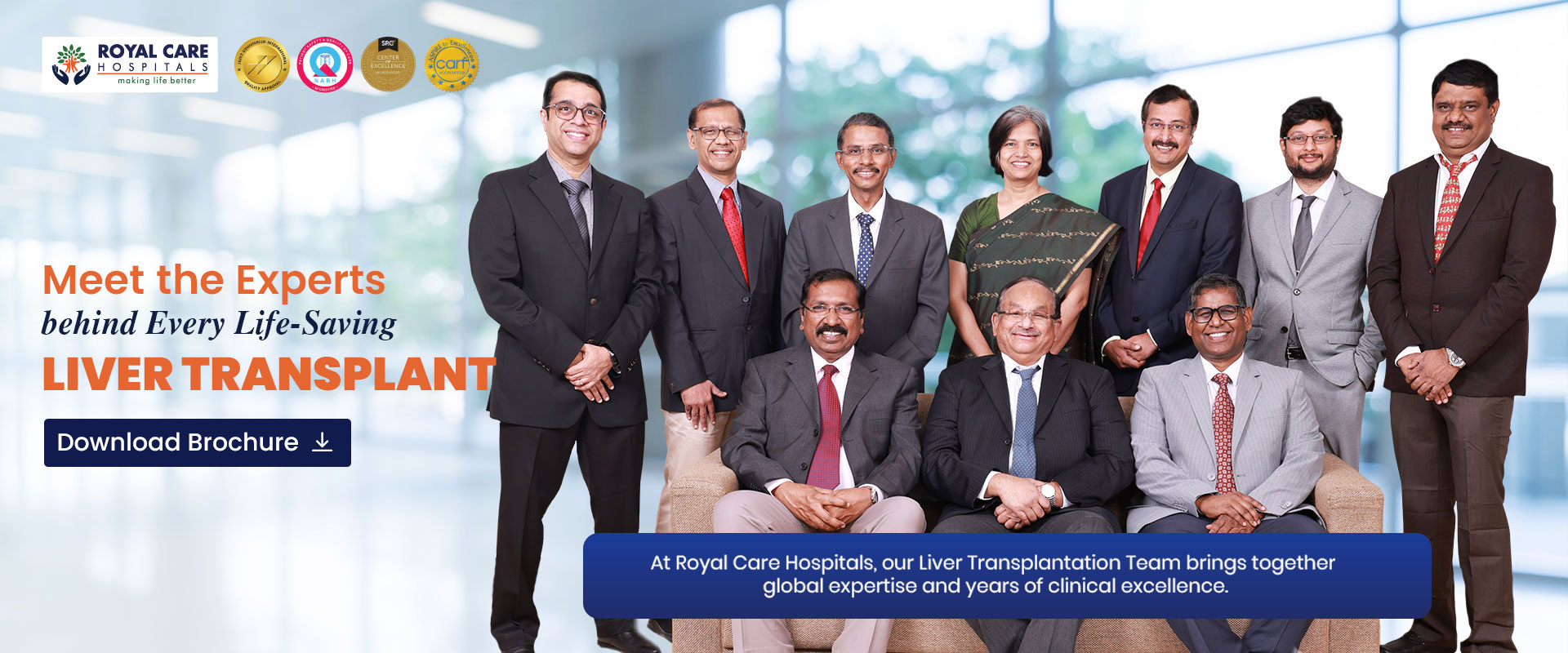
The Royal Care liver transplant program is led by internationally trained transplant expertise with experience in adult and pediatric liver transplantation, renal transplantation, and technically complex hepatobiliary surgery.




Successful liver transplantation depends on coordinated multidisciplinary care. At Royal Care, transplant management integrates clinical excellence across all specialties — especially critical in high-risk recipients, children, and technically complex surgical situations.
If you or your patient needs liver transplant evaluation, early consultation can help define the diagnosis, timing, and treatment pathway.