Number of Specialists
No of patients
No of surgeries done
Use our quick BMI calculator and screening questions to understand your weight-related health risks.
Calculate your Body Mass Index
Enter your height and weight to calculate your BMI.
Understand your BMI result
The assessment should consider pre-pregnancy weight gain, metabolic health, and individual clinical factors.
Answer “Yes” or “No” to the following questions:
Do I feel I am gaining excess weight?
Do I often crave fried or sugary foods?
Do I feel hungry frequently, even after eating?
Do I find everyday movements or activities difficult?
Do I get breathless while climbing stairs or walking?
Has a doctor ever told me that I am overweight or obese?
A comprehensive obesity assessment should consider body fat distribution, waist circumference and metabolic health in addition to BMI.
BMI is one of the primary measures used to assess whether a person is underweight, within the healthy range, overweight, or has obesity.
Measuring waist circumference is important because it indicates the amount of abdominal fat, which is associated with a higher risk of metabolic and cardiovascular health problems. A person can have a BMI that appears normal but still have excess abdominal fat.
Body shape and fat distribution also matter. A person may have a normal BMI but carry excess visceral fat and have metabolic abnormalities—sometimes described as having a normal-weight or metabolically unhealthy phenotype. Therefore, BMI alone may not provide a complete picture of obesity-related health risk.
A structured and personalised approach to obesity and metabolic health management.
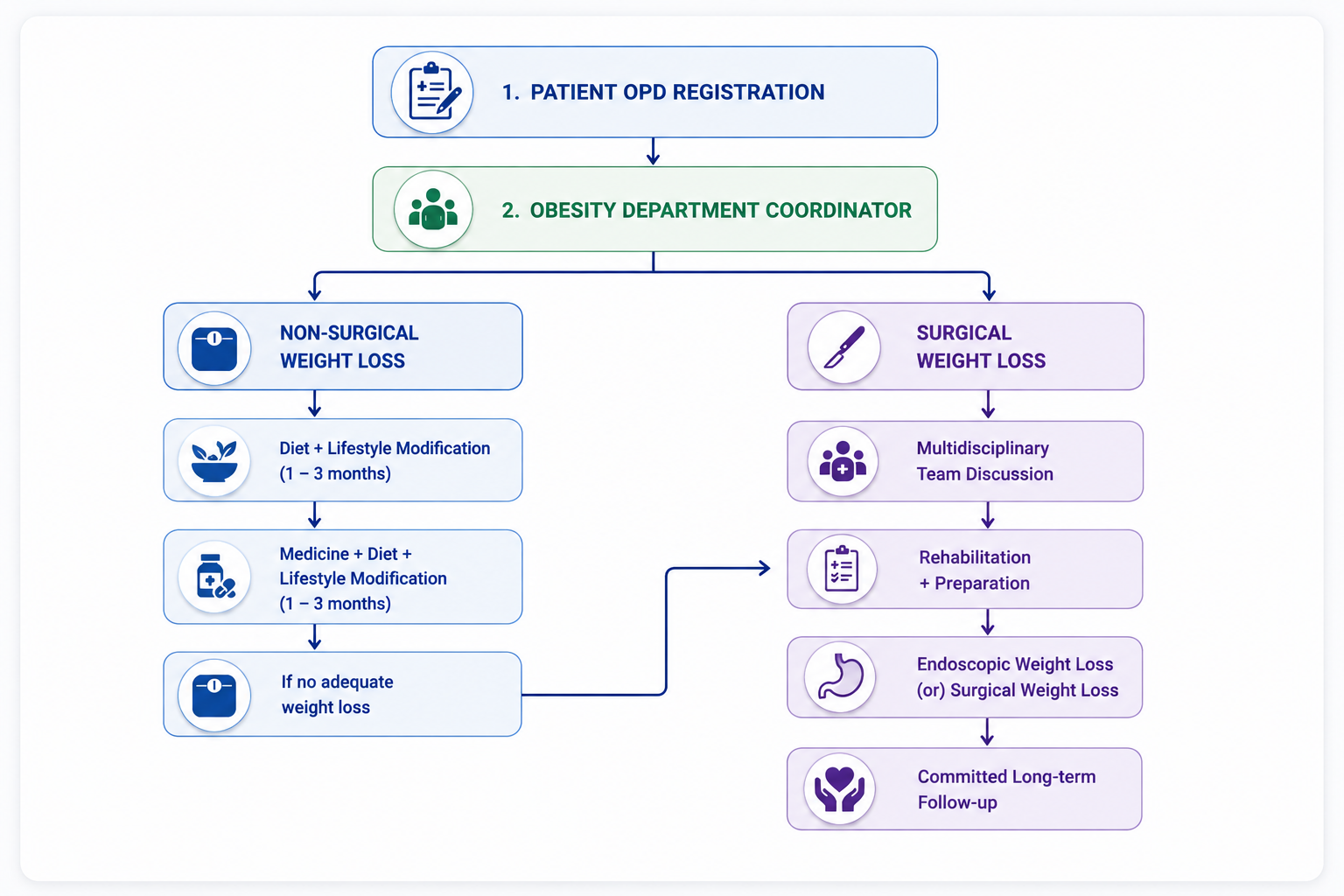
Endoscopic bariatric procedures use a flexible endoscope introduced through the mouth to access the stomach. Unlike conventional bariatric surgery, these procedures do not require external abdominal incisions.
Endoscopic interventions may be considered for selected patients who require additional support for weight loss but may not need, or may not be ready for, conventional bariatric surgery.
Endoscopy can also play an important role in evaluating the upper gastrointestinal tract before or after certain weight-management interventions. It may help doctors assess conditions such as gastritis, ulcers, reflux-related changes, or other abnormalities when clinically indicated.
Patients undergoing endoscopic weight-loss procedures receive appropriate pre-procedure assessment, anaesthesia support, post-procedure monitoring, nutritional guidance, and follow-up.
The suitability of an endoscopic procedure depends on individual factors including BMI, medical history, previous weight-loss attempts, eating patterns, metabolic health, and overall treatment goals.
For individuals with severe obesity or obesity-related metabolic conditions, bariatric surgery can provide an effective long-term treatment option when combined with appropriate lifestyle and nutritional care.
Our surgical team offers advanced minimally invasive approaches, including laparoscopic and robotic-assisted procedures where appropriate.
This procedure creates a smaller stomach pouch and connects it to a segment of the small intestine through a single surgical connection. It combines restrictive and metabolic effects and may be considered for selected patients after comprehensive evaluation.
Some patients who have undergone previous bariatric surgery may experience inadequate weight loss, weight regain, or procedure-related complications. Revision procedures are tailored to the individual’s previous surgery, current anatomy, health status, and treatment goals.
For selected patients with obesity and inadequately controlled type 2 diabetes, metabolic surgery may help improve blood glucose control and metabolic health. Suitability is determined following a comprehensive assessment by the multidisciplinary team.
Surgery is only one part of successful long-term weight management. Our programme includes:

MD, DM (Gastro), Fellowship in advanced Endoscopy, M.ACG.,
Consultant Gastroenterologist, Hepatologist & Interventional Endoscopist

MS, M.Ch (SGE), DNB (GI.Surgery), FALS (Bariatric).,
Consultant Surgical Gastro, Advanced Laparoscopic, HPB,GI Oncology and Bariatric Surgeon

MD, DM (Endo) - PGI Chandigarh.,
Consultant Endocrinologist & Diabetologist

MD, PG Diab (Boston).,
Consultant Internal Medicine & Diabetologist

MD, DNB (Resp Dis).,
Consultant Endocrinologist & Diabetologist

MD, DM (Cardio).,
Consultant Interventional Cardiologist

MD (OG), Dip, Gyn. Endoscopy (Ger),Master's degree in Biotechnology of Human Assisted Reproduction & Embryology (Spain), MBA.,
Consultant Infertility Specialist,Advanced Gynaec Laparoscopic & Robotic Surgeon

MBBS, MD(Psychiatry)
Consultant Psychiatrist

MS ortho, DNB., FoTs(Trauma fellow), FASM (Arthroscopy), Shoulder Fellow (Japan).,
Consultant Arthroscopy, Joint Replacement and Trauma

MD (PMR), DNB (PMR), DPMR.,
Consultant Physiatrist & Head of the Department
Obesity is a chronic medical condition influenced by multiple factors, including genetics, metabolism, hormones, nutrition, physical activity, sleep, medications, and behavioural factors. It often requires structured medical care rather than lifestyle changes alone.
Treatment is personalised based on factors such as BMI, body composition, medical history, metabolic health, previous weight-loss attempts, medications, eating patterns, and individual goals. Treatment may include lifestyle modification, medical therapy, endoscopic procedures, or bariatric surgery.
Endoscopic weight-loss procedures are minimally invasive treatments performed through the mouth using a flexible endoscope. Certain procedures reduce the effective capacity of the stomach or temporarily occupy space within it, helping patients control food intake and support weight loss.
ESG is a minimally invasive endoscopic procedure in which sutures are placed within the stomach to reduce its effective size and create a sleeve-like configuration. It does not require external abdominal incisions and may be considered for selected patients as part of a comprehensive weight-management programme.
Endoscopic procedures are performed through the mouth and generally do not involve external surgical incisions, whereas bariatric surgery involves an operation on the stomach and/or digestive tract. The appropriate option depends on the patient's medical condition, weight, metabolic health, previous treatment, and treatment goals.
Endoscopic procedures are appropriate only for selected patients following a detailed medical evaluation. The specialist team will assess BMI, medical conditions, previous weight-loss efforts, eating patterns, and other factors before recommending treatment.
Laparoscopic bariatric surgery uses small abdominal incisions and specialised instruments. Compared with conventional open surgery, it may offer reduced post-operative pain, smaller scars, shorter hospital stays, and faster recovery in appropriately selected patients.
For selected patients with obesity and type 2 diabetes, metabolic or bariatric surgery can significantly improve blood glucose control and may reduce the need for diabetes medications. The decision is made after a comprehensive metabolic and medical evaluation.
Yes. Nutrition is an essential part of successful weight management. Patients receive personalised dietary guidance and regular nutritional monitoring to support healing, adequate nutrition, healthy weight loss, and long-term weight maintenance.
Yes. Obesity is a chronic condition, and long-term follow-up is important even after achieving significant weight loss. Regular reviews help monitor weight, nutrition, metabolic health, lifestyle habits, and any obesity-related conditions.