" JCI & NABH Accredited Hospital "

Emergency +91 91434 91434

General Enquiry +91 422 2227000

Liver Transplant Program

Advanced Adult &
Pediatric Liver
Transplant Care

Royal Care Superspeciality Hospital offers a dedicated liver transplant program for adults and children with end-stage liver disease, acute liver failure, liver cancer, and complex hepatobiliary disorders from evaluation through long-term follow-up.

Why Patients and Families Choose Royal Care?

Adult and pediatric liver transplant expertise
Internationally trained transplant leadership
Experience in living donor and deceased donor liver transplantation
Expertise in small infants and high-risk recipients
Structured multidisciplinary care
160+
Specialists
2,00,000+
Patients Treated
50,000+
Surgeries Done
Why Royal Care

Why Choose Royal Care for Liver Transplantation?

Royal Care Super Specialty Hospital provides a comprehensive liver transplant program designed for both standard and complex transplant cases. Our transplant pathway combines surgical expertise, critical care, imaging, anesthesia, hepatology, pediatric support, and structured postoperative monitoring under one program.

  • Comprehensive adult liver transplant care
  • Specialized pediatric liver transplant capability
  • Living donor liver transplantation (LDLT)
  • Deceased donor liver transplantation (DDLT)
  • Split liver transplantation & reduced graft strategies
  • Expertise in graft-recipient size mismatch
  • Complex venous outflow planning
  • Structured donor and recipient evaluation
  • Multidisciplinary perioperative management
  • Long-term follow-up and immunosuppression guidance

Our Program Difference

We focus not only on performing liver transplantation, but on selecting the right patients, optimizing them before surgery, choosing the best graft strategy, and delivering sustained follow-up after transplant.

🏥
JCI & NABH Accredited International standard quality protocols
🌐
International Training Fellowship from USA, Japan, Pittsburgh
👶
Pediatric Expertise Including babies under 5 kg
🔬
MDT Approach 10+ specialties coordinated in one program
Services

Our Liver Transplant Services

Living Donor Liver Transplantation (LDLT)

Living donor liver transplantation is an important option for patients who need timely transplantation and have a suitable healthy donor. It allows earlier surgical planning and may reduce the risk of deterioration while waiting for a deceased donor organ.

Who May Benefit
  • Decompensated chronic liver disease
  • Acute deterioration in cirrhosis
  • Liver cancer within accepted transplant criteria
  • Children requiring timely transplantation
  • Patients unlikely to safely wait for deceased donor allocation
Our Focus in LDLT
  • Careful donor and recipient evaluation
  • Graft selection based on recipient need and body size
  • Planning for venous outflow and inflow adequacy
  • Reduced graft strategies in selected small-frame recipients
  • Adult and pediatric LDLT pathways
Key Advantage
Living donor transplantation allows elective surgical timing, enabling optimal patient preparation and reducing risk from extended organ waitlists.
Donor Safety
Donor evaluation is conducted independently with full medical and psychological assessment. Donor safety and informed consent are non-negotiable priorities.
Pediatric Pathway
For children, a left lateral segment or monosegment graft from a living parent donor is often the safest and most timely option.

Deceased Donor Liver Transplantation (DDLT)

Deceased donor liver transplantation remains a key treatment pathway for patients with advanced liver disease and acute liver failure. It is particularly important where a suitable living donor is not available or when urgent transplantation is required.

Who May Benefit
  • End-stage chronic liver disease
  • Acute liver failure
  • Liver cancer in eligible transplant settings
  • Selected metabolic and cholestatic liver diseases
  • Patients without a suitable living donor
Our Focus in DDLT
  • Rapid recipient assessment and readiness
  • Organ suitability assessment
  • Marginal donor graft optimization where appropriate
  • Perioperative planning for complex recipients
  • Intensive monitoring in the early post-transplant period
Urgent Cases
Patients with acute liver failure and high MELD scores are prioritized. Our team maintains readiness for rapid recipient assessment and organ acceptance decisions.
Marginal Grafts
In selected situations, marginal donor grafts can be carefully utilized to expand transplant access for recipients who would otherwise remain on extended waitlists.

Split Liver Transplantation

Split liver transplantation allows one donor liver to benefit more than one recipient in selected situations. It is especially important in pediatric transplantation and may increase access to transplantation in properly selected patients.

Our Focus
  • Recipient selection and size-appropriate graft allocation
  • Technical planning for pediatric and small adult recipients
  • Structured perioperative management
  • Optimization of outcomes in high-complexity graft implantation
Transplant Access
Split liver transplantation maximizes the benefit of each donor organ, allowing both a pediatric and adult recipient to receive a life-saving transplant from one graft.
Technical Precision
Ex-vivo or in-situ splitting requires detailed vascular and biliary planning. Our team has the expertise for both approaches in appropriate cases.

Reduced Graft Transplantation

Some recipients require graft tailoring because of body size mismatch or anatomical considerations. Reduced graft strategies help achieve safer implantation and improved physiological fit in carefully selected patients.

Our Focus
  • Reduced liver allografts in small-frame patients
  • Technical planning for graft volume and venous drainage
  • Outflow-oriented reconstruction strategy
  • Recipient-specific surgical tailoring
Small-Frame Recipients
Body size mismatch is a common challenge in pediatric transplantation. Reduced grafts allow life-saving transplantation in children who cannot accommodate full-size organs.
Surgical Planning
Detailed preoperative imaging and volumetric planning ensure the reduced graft will provide adequate functional liver mass while fitting safely within the recipient's anatomy.

Pediatric Liver Transplantation

Specialized transplant care for infants, children, and adolescents — with a dedicated pathway from evaluation through long-term follow-up.

✦ Liver transplantation in babies weighing less than 5 kg
✦ Monosegment graft transplantation
✦ Reduced graft strategies for very small infants
✦ Pediatric acute liver failure
✦ Complex pediatric metabolic indications
For Children

Specialized Pediatric Liver Transplant Care

Pediatric transplantation requires a distinct expertise — in evaluation, graft selection, surgical technique, anesthesia, critical care, metabolic disease management, and long-term follow-up. Our program is equipped for the youngest and most complex pediatric recipients.

We Evaluate & Manage Children With
Biliary atresia & end-stage pediatric liver disease
Pediatric acute liver failure
Neonatal acute liver failure
Urea cycle defects
Glycogen storage diseases
Cholestatic & metabolic liver disease
Alagille syndrome with vascular complexity
Syndromic & congenital liver disorders
Complex Cases

Liver Transplantation for Complex Indications

Liver transplantation is not limited to end-stage cirrhosis alone. Many patients require transplant evaluation because of specific disease patterns, urgency, or complex anatomical and oncological considerations.

Liver Cancer (HCC)

Selected patients with hepatocellular carcinoma within transplant criteria may benefit from liver transplantation as definitive oncological treatment.

Budd-Chiari Syndrome

Liver transplantation for Budd-Chiari with progressive liver failure requires careful planning given complex hepatic venous anatomy.

Acute Liver Failure

Rapid assessment and listing is essential. Our team maintains readiness for urgent transplantation in acute liver failure situations.

Re-Transplantation

Selected patients with primary graft failure or late graft dysfunction may be evaluated for re-transplantation in experienced centers.

Complex Vascular & Biliary

Unusual portal or hepatic venous anatomy, biliary atresia in adults, and prior hepatic surgery require specialized surgical planning.

Marginal Graft Optimization

In carefully selected patients, marginal grafts can be utilized to expand transplant access — with appropriate perioperative support.

Machine Perfusion

Emerging machine perfusion technology can improve graft assessment and viability, particularly for marginal and extended-criteria donor organs.

Portal Hypertension Surgery

Surgery in the setting of portal hypertension and advanced liver disease demands specialized hepatobiliary surgical experience.

The Process

Your Liver Transplant Journey at Royal Care

We aim to make the transplant pathway structured, understandable, and coordinated for patients and families.

01

Initial Consultation

The patient is assessed for disease severity, urgency, transplant indication, and immediate risks.

02

Recipient Evaluation

This includes liver disease assessment, cardiopulmonary evaluation, infection screening, nutritional review, imaging, and transplant fitness assessment.

03

Donor Evaluation

Where living donor transplantation is considered, suitable donor assessment is done carefully and independently.

04

Multidisciplinary Review

The transplant team reviews the patient's diagnosis, suitability, timing, surgical considerations, and risk profile.

05

Surgical Planning

Recipient anatomy, donor anatomy, graft strategy, vascular planning, and perioperative risks are assessed in detail.

06

Liver Transplantation

The transplant procedure is performed with structured intraoperative and postoperative monitoring.

07

ICU & Inpatient Recovery

Postoperative care focuses on graft function, hemodynamic support, infection prevention, immunosuppression, and recovery milestones.

08

Long-Term Follow-Up

Patients require continued transplant clinic follow-up, graft surveillance, immunosuppression management, and complication monitoring.

Our Specialists

Led by Internationally Trained Transplant Expertise

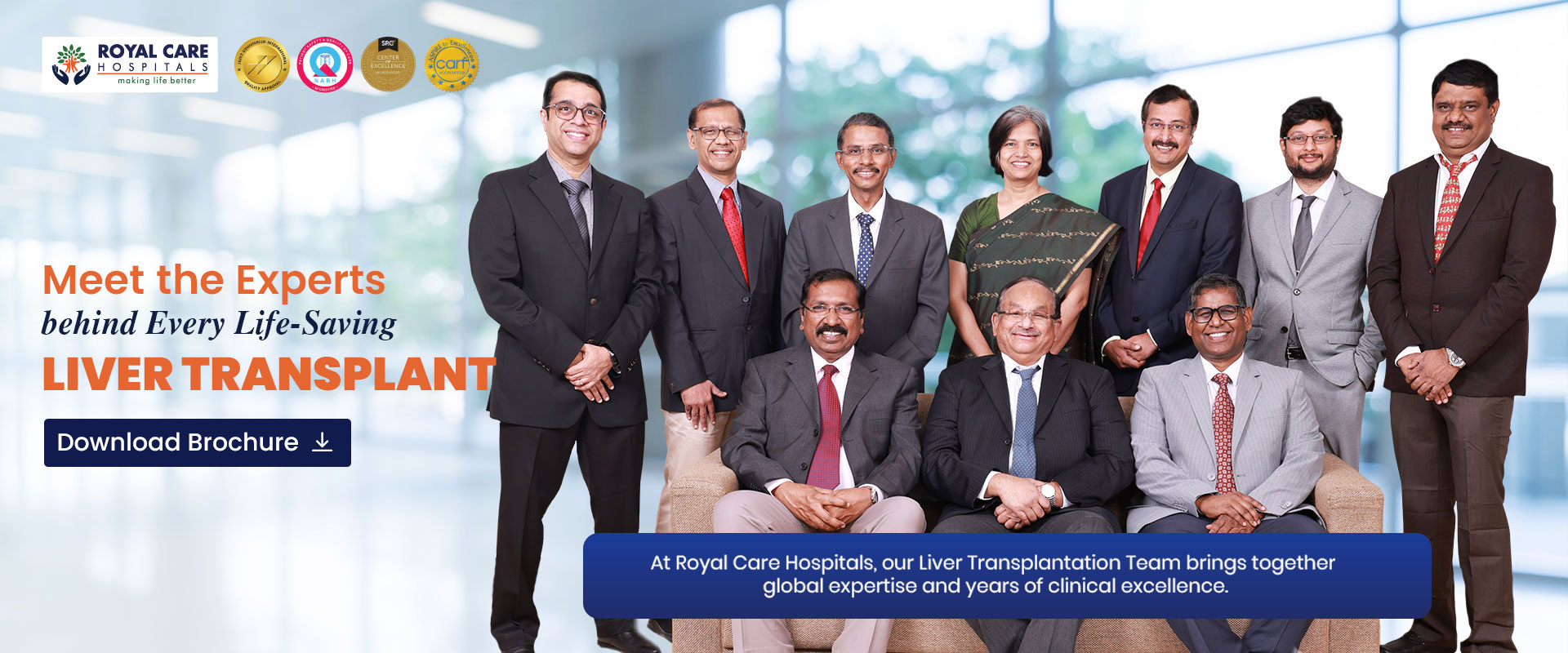
The Royal Care liver transplant program is led by internationally trained transplant expertise with experience in adult and pediatric liver transplantation, renal transplantation, and technically complex hepatobiliary surgery.

Dr. Ilango Sethu
Dr. Ilango Sethu
MS, MCh (GI & HPB Surgery), ASTS Multiorgan Transplant Fellowship (USA), Pediatric Liver Transplant Fellowship (Japan), FACS
Consultant – HPB & Abdominal Multi-Organ Transplant Surgeon
Dr. Hemamala Ilango
Dr. Hemamala Ilango
MBBS, MD General Medicine, DM Medical Gastroenterology, Fellowship in Transplant Hepatology (Pittsburgh)
Consultant Hepatologist & Liver Transplant Physician
Dr. S. Soundappan
Dr. S. Soundappan
MBBS, MS, MRCS(UK), DNB-Surg Gastro, FALS-Robotic, Fellowship-Hepatobiliary Surgery, Fellowship-Liver Transplant (CLBS, Delhi)
Consultant – Gastro, MIS, HPB, GI Oncology & Liver Transplantation Surgeon
Dr. S. V. Abhinaya
Dr. S. V. Abhinaya
MBBS, MD (Anesthesia), DM (Organ Transplant Anaesthesia & Critical Care)
Consultant Anaesthesiologist
Dr. S. V. Abhinaya
Dr. Seema Math
MBBS, MS, MRCS(UK),General Surgery, Fellowship in Minimal invasive surgical gastro, HPB Liver transplant, Gastro Liver, Transplant
Consultant - Gastro, and Liver Transplant Surgeon
Team Approach

Multidisciplinary Liver Transplant Care

Successful liver transplantation depends on coordinated multidisciplinary care. At Royal Care, transplant management integrates clinical excellence across all specialties — especially critical in high-risk recipients, children, and technically complex surgical situations.

Liver Transplant Surgery Hepatology Pediatric Liver Care Transplant Anesthesia Critical Care Interventional Radiology Advanced Imaging Endoscopy Support Nutrition & Rehabilitation Long-term Follow-up

When Should a Patient be Referred?

1
Cirrhosis with ascites, recurrent encephalopathy, or variceal bleeding
2
Acute liver failure or rapidly worsening jaundice with coagulopathy
3
Liver cancer within transplant consideration criteria
4
Pediatric end-stage liver disease or metabolic liver disease
5
Clinical decline despite maximal medical management
6
Budd-Chiari syndrome with worsening liver function
Request Referral
FAQ

Frequently Asked Questions

Common questions from patients and families about liver transplantation at Royal Care.

Speak to Our Team
A liver transplant may be needed in end-stage liver disease, acute liver failure, selected cases of liver cancer, pediatric metabolic liver disease, and some cholestatic or vascular liver disorders.
Living donor liver transplantation uses a portion of liver from a healthy donor, while deceased donor liver transplantation uses a liver from a deceased donor. The best pathway depends on urgency, donor availability, and disease type.
Yes. The program includes pediatric liver transplant evaluation and management, including very small infants, metabolic liver disease, and acute liver failure.
Referral should be considered once decompensation begins, such as ascites, encephalopathy, variceal bleeding, jaundice, or progressive decline despite treatment.
Yes, selected patients with liver cancer may be eligible for transplantation depending on disease burden, liver status, tumor biology, and treatment pathway.
Yes, selected babies less than 5 kg may undergo liver transplantation in experienced centers with careful graft planning and pediatric perioperative support.
This depends on urgency, disease severity, donor pathway, and clinical complexity. Some cases can be fast-tracked when urgent.
You can contact Royal Care Super Specialty Hospital to schedule a liver transplant evaluation or speak to the transplant coordination team.

Book a Liver Transplant Evaluation

If you or your patient needs liver transplant evaluation, early consultation can help define the diagnosis, timing, and treatment pathway.